
 SkyCare
  Air Repatriation
What Is Medical Repatriation? A Guide for Patients & Families
Medical repatriation is the safe transfer of a person who becomes ill or injured away from home to a place where they can continue their treatment or recovery. For UK patients abroad, that often means organising a medically supported journey back to the UK, with the right clinical team, equipment and transport arranged around the patient’s condition.
It can sound complicated when you first hear the term. In practice, the aim is simple: move someone safely from their current hospital or location to the right destination, while maintaining continuity of care throughout the journey.
What does medical repatriation actually involve?
A proper repatriation is much more than booking a flight home. The journey may involve hospital liaison, medical assessment, airline or aircraft planning, ground ambulances at both ends, medical equipment, medication, airport assistance and a formal handover to the receiving hospital, care home or family.
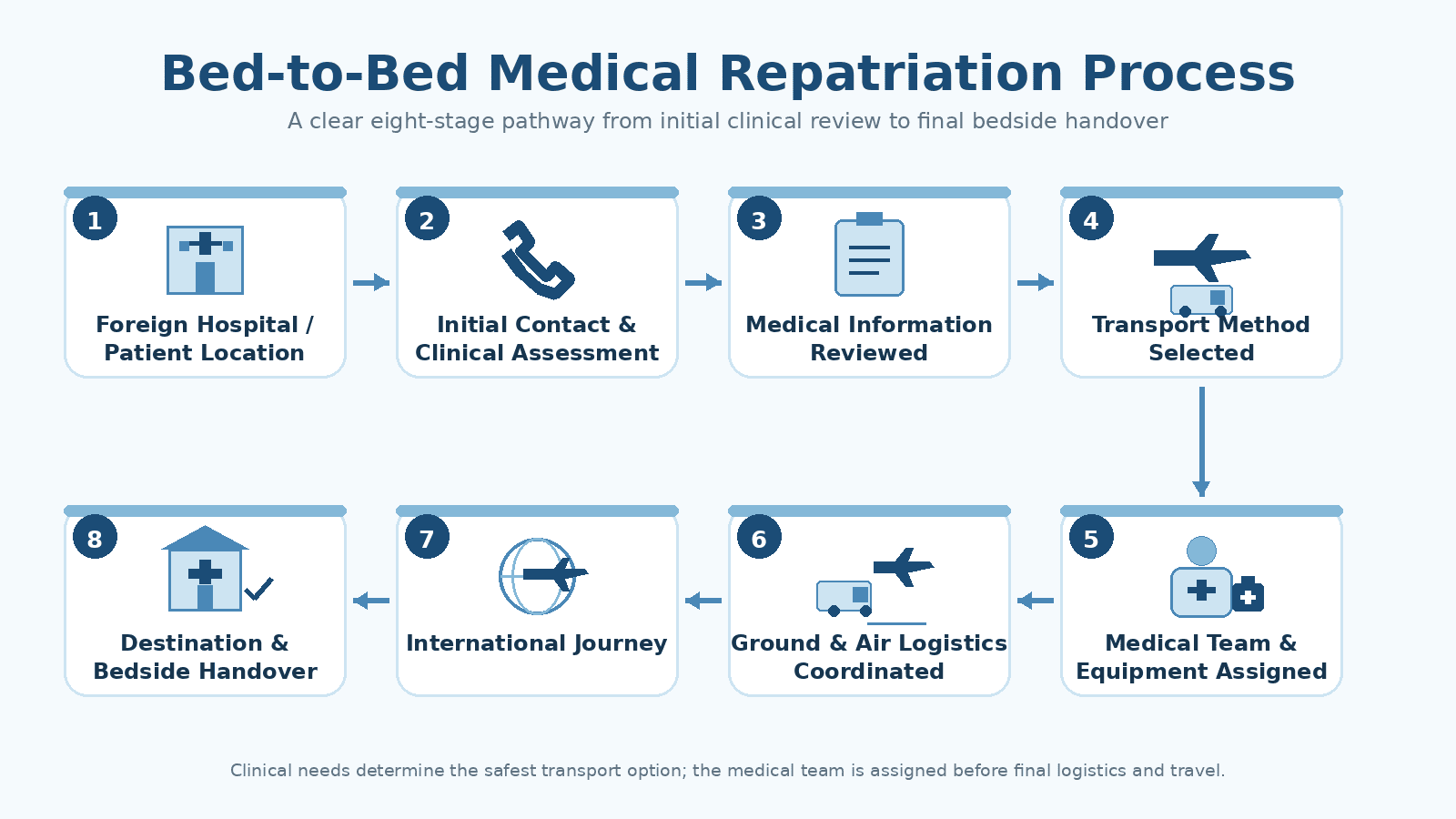
That is why medical repatriation is often described as a bed-to-bed service. The patient is collected from the sending hospital or residence, medically supported during the journey, and handed over safely at the final destination.
When might medical repatriation be needed?
People require medical repatriation for many different reasons. A traveller may have suffered a stroke, fracture, cardiac event, serious infection or accident abroad. Someone with a pre-existing condition may deteriorate unexpectedly, or a patient may simply be medically stable enough to leave an overseas hospital but not well enough to travel home without support.
Repatriation can also be appropriate when long-term recovery would be better managed closer to family, a usual medical team or a specialist UK hospital. The important question is not simply whether a person wants to travel, but whether they can travel safely and what level of medical support they require.
How does medical repatriation work?
Every case is different, but the planning process normally follows the same clinical logic:
- Initial assessment. The patient’s condition, diagnosis, mobility, oxygen requirements, medication and current location are reviewed.
- Medical information is gathered. With the appropriate permission, the repatriation team liaises with the treating hospital or doctor and obtains the clinical information needed to plan the transfer.
- Fitness to travel is considered. Clinicians assess whether a commercial flight is realistic or whether a dedicated air ambulance or road transfer is safer.
- The transport plan is built. Flights, medical escorts, equipment, ambulances and receiving arrangements are coordinated around the patient’s needs.
- The patient is transferred. The medical team monitors and supports the patient throughout the journey.
- Clinical handover takes place. On arrival, relevant medical information is passed to the receiving hospital, care provider or family.
Families should also receive clear updates along the way. When a relative is ill hundreds or thousands of miles from home, knowing what happens next is almost as important as knowing what has already happened.
What are the main medical repatriation options?
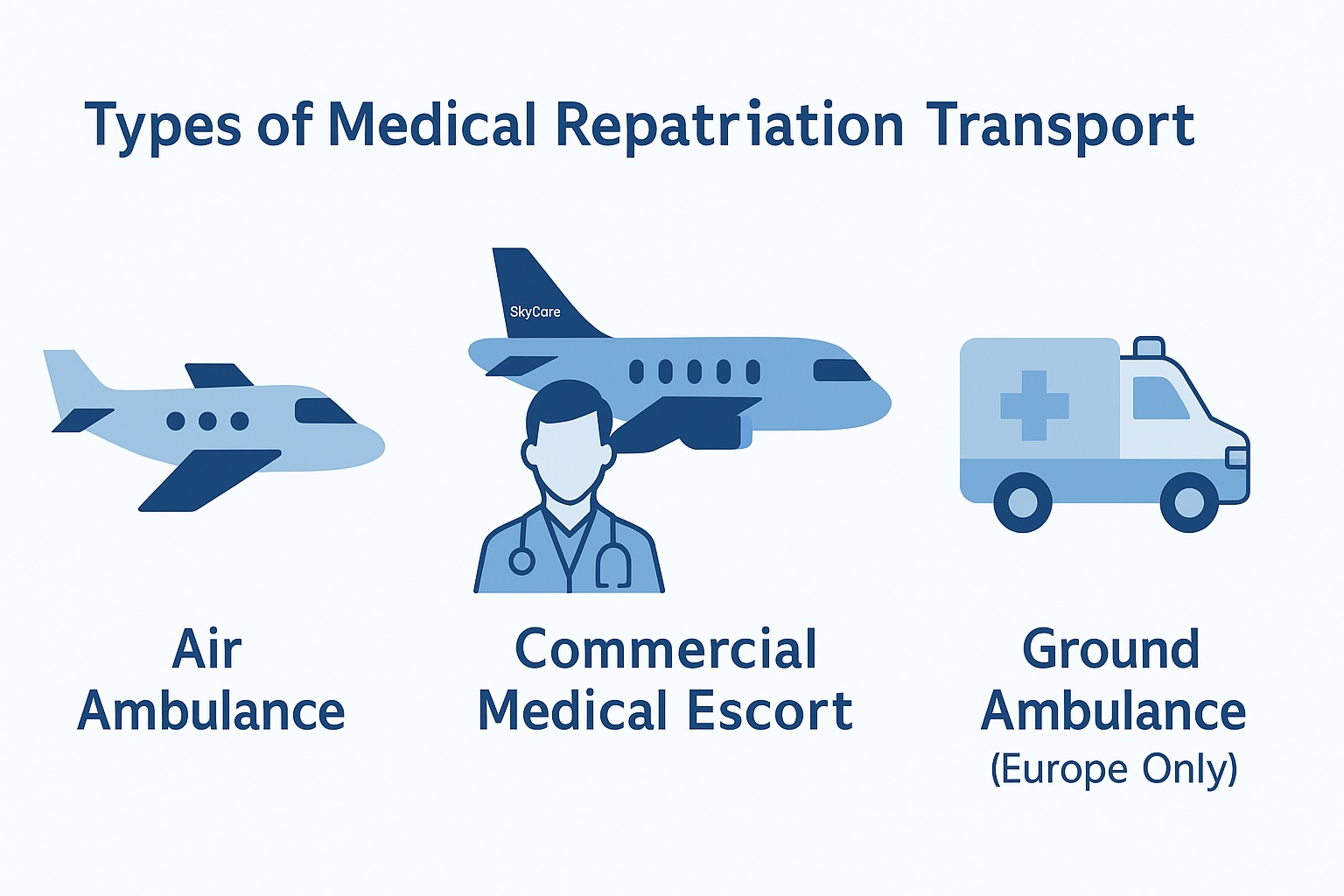
There is no single type of medical repatriation. The safest and most proportionate option depends on the patient’s condition, the journey and the level of medical intervention that may be needed in transit.
Air ambulance
A dedicated air ambulance is generally used when a patient requires a higher level of monitoring or treatment during the flight, cannot safely travel through a commercial airport environment, or needs specialist equipment and a clinical team throughout the journey.
The aircraft is configured for medical transport and can carry equipment appropriate to the patient’s care plan. For complex international cases, the service is usually coordinated with ground ambulances at both ends.
Commercial flight with a medical escort
Many stable patients do not need a private aircraft. A commercial medical escort can allow a patient to travel on a scheduled airline with a nurse, paramedic or doctor providing support according to the clinical plan.
Depending on the airline and the patient’s condition, this may involve a normal seat, additional seating, wheelchair assistance or, on certain routes and aircraft, a stretcher arrangement.
European road ambulance
For some journeys within Europe, a long-distance road ambulance can be an effective alternative to flying. It avoids airports and aircraft transfers, and can offer a continuous hospital-to-hospital or hospital-to-home journey with the patient remaining on the same stretcher.
Distance, road time, clinical condition and comfort all need to be considered. A road transfer is not automatically the cheapest or safest option simply because the starting point is in Europe.
How is the right repatriation method chosen?
The safest method is selected by looking at the patient rather than starting with the aircraft. Important factors include medical stability, diagnosis, consciousness, mobility, pain, oxygen needs, infection risk, ability to sit upright, risk of deterioration, length of journey and the facilities available at the destination.
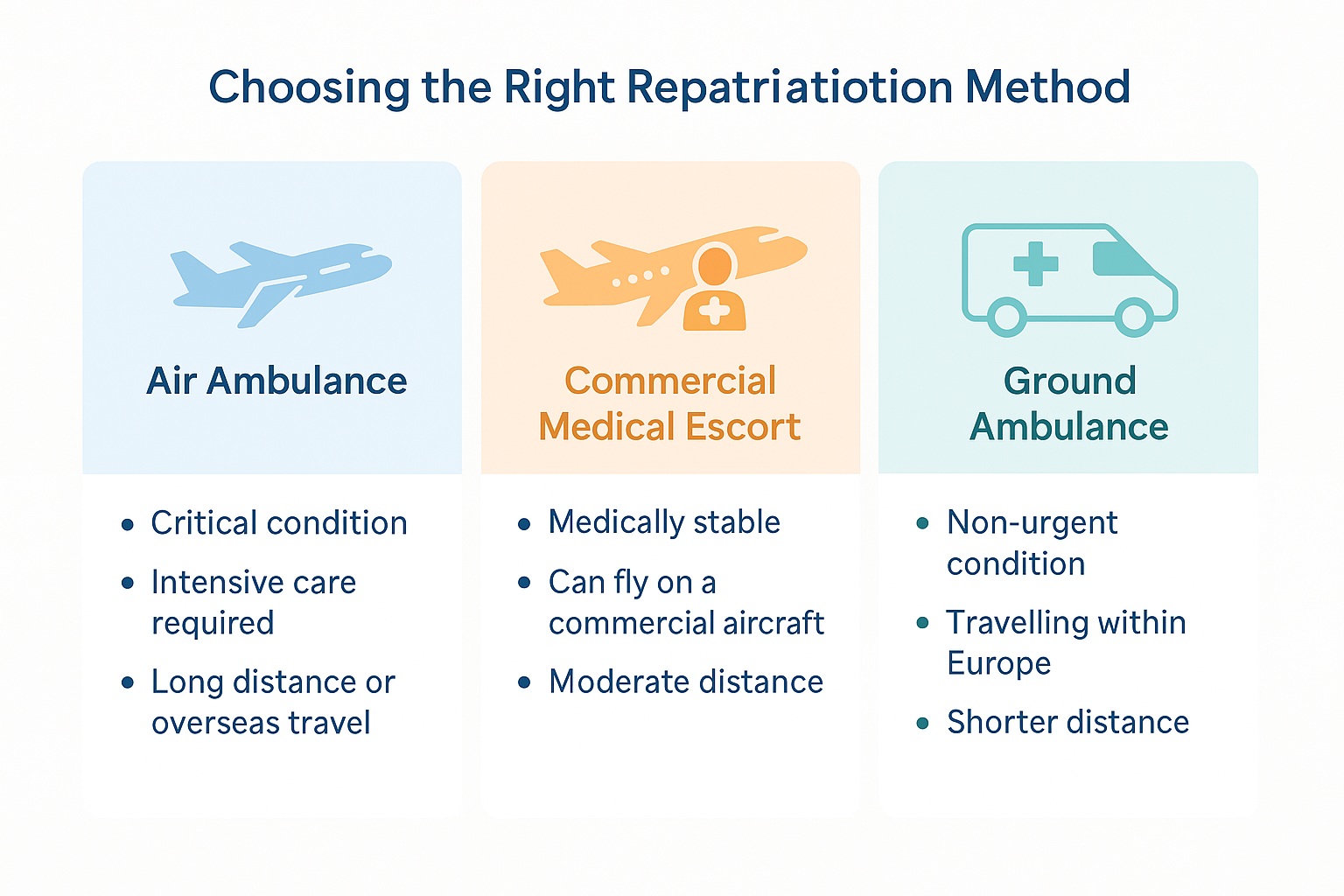
Cost matters too, particularly for privately funded families, but it should be considered after the medically suitable options have been established. In some cases a commercial medical escort can provide a significantly more economical solution than a dedicated air ambulance. In other cases, trying to force a patient onto a scheduled flight simply to save money would be inappropriate.
Who decides whether a patient is fit to fly?
Fitness to fly is a medical and operational decision rather than a simple yes-or-no certificate. The treating doctor may confirm the patient’s current condition, while the repatriation medical team considers how that condition is likely to behave during the planned journey.
Commercial airlines may also require their own medical clearance process. This is often referred to as MEDIF clearance and can involve airline medical departments reviewing information supplied by the patient’s doctor and escort team.
For dedicated air ambulance transfers, the medical team plans the transport around the patient’s clinical requirements and the capabilities of the aircraft.
Can medical repatriation be arranged privately?
Yes. Medical repatriation is often organised through travel insurers or assistance companies, but families can also arrange and fund a transfer privately.
If an insurer has refused cover, delayed a decision or decided that repatriation is not medically necessary under the policy, private arrangements may still be possible. Our guide to what to do if insurance will not cover medical repatriation explains the options in more detail.
How much does medical repatriation cost?
There is no meaningful single price because the cost depends on the country, distance, medical team, aircraft or airline requirements, ground ambulances, equipment, airport handling and how quickly the transfer must be arranged.
A commercial medical escort is usually less expensive than a dedicated air ambulance when the patient is medically suitable for scheduled travel. Road ambulance can also be cost-effective on certain European routes. Complex long-haul air ambulance transfers are considerably more expensive because the aircraft, specialist crew, fuel, permits and medical configuration are dedicated to one patient.
For a fuller explanation, see our medical repatriation cost guide.
How quickly can medical repatriation be arranged?
Urgent transfers can sometimes be organised very quickly, but timing depends on obtaining sufficient medical information, identifying the right transport option, airline or aircraft availability, medical staff, ground transport, passports or travel documents, permits and the receiving destination.
A realistic plan is usually safer than promising an arbitrary departure time before the clinical and logistical picture is clear.
What information is needed to start arranging a repatriation?
If you are trying to bring a relative home, it helps to have the following information available:
- the patient’s full name, date of birth and nationality;
- their current hospital, clinic or address;
- the treating doctor’s or ward’s contact details;
- a recent medical report or discharge summary, if available;
- details of any oxygen, medication, mobility or monitoring requirements;
- the preferred destination in the UK or another country; and
- insurance details, if an insurer is involved.
Do not worry if you do not have everything. In many cases the first useful step is simply identifying where the patient is and who is treating them.
What does bed-to-bed medical repatriation mean?
Bed-to-bed means the transfer is coordinated as one continuous medical journey rather than leaving the family to arrange separate pieces themselves. It can include collection from the overseas hospital, transfer to the airport, the flight itself, arrival assistance, a UK ambulance and handover at the final hospital or home.
This is particularly valuable when the patient has limited mobility or when several organisations need to work together. The purpose is to reduce gaps in responsibility and maintain continuity of care.
Clinical governance and safety
Medical repatriation involves both healthcare and transport, so families should ask who is clinically responsible for the journey, what medical professionals will travel with the patient, what equipment is available and how the final handover will be managed.

SkyCare’s UK medical services are regulated by the Care Quality Commission (CQC).
What should you do if someone needs medical repatriation now?
Start by obtaining the patient’s current medical details and the contact information for the hospital or doctor looking after them. From there, a repatriation team can assess the available transport options and explain what is realistically required.
If you are unsure whether the patient needs an air ambulance, medical escort or road ambulance, you do not need to make that decision yourself. The transport method should follow the clinical assessment.
SkyCare coordinates international medical repatriation for patients returning to the UK and for patients travelling between other countries. You can contact the SkyCare team for an initial discussion or request a repatriation quote.
