
 SkyCare
  Medical Advice
Can You Fly After a Stroke or TIA? When Is It Safe?

Can You Fly After a Stroke or TIA?
Yes, many people can fly after a stroke or transient ischaemic attack (TIA), but not immediately. Current UK Civil Aviation Authority guidance for neurological conditions advises waiting at least 2 weeks after a stroke and 2 days after a TIA before flying. These are general minimum intervals, not automatic clearance to travel: your treating clinician should consider the type and severity of the event, your recovery, the cause of the stroke or TIA, medication, mobility and any ongoing complications.
If you develop new stroke or TIA symptoms now — such as facial weakness, arm weakness or numbness, or sudden speech problems — this is an emergency. In the UK, call 999. Do not wait to see whether the symptoms improve and do not board a flight. The NHS advises urgent hospital assessment even when symptoms disappear, because a TIA can be a warning of a subsequent stroke.
This guide covers two different situations: planning ordinary air travel after recovery, and getting home safely after suffering a stroke abroad. They require different decisions.
How Long Should You Wait Before Flying After a Stroke?
The CAA’s current neurological guidance advises waiting at least 2 weeks following a stroke. After a TIA, it advises waiting at least 2 days. Your own doctor or stroke specialist may recommend waiting longer depending on your clinical condition.
Read the current UK CAA neurological guidance.
Why Isn’t There One Safe Date for Everyone?
A stroke can affect movement, speech, swallowing, vision, cognition, balance and continence to very different degrees. The underlying cause also matters. Someone who has made a good recovery from a relatively small stroke may have very different travel needs from a patient with significant weakness, swallowing difficulties, reduced consciousness or an unstable cardiovascular condition.
The minimum waiting period therefore does not replace individual assessment. Your clinician may need to consider whether the condition that caused the stroke has been investigated and treated, whether you are medically stable, and whether you can safely manage the physical demands of the airport and flight.
Can You Fly After a TIA or Mini-Stroke?
A TIA should never be dismissed because the symptoms have disappeared. The NHS describes a TIA as a temporary disruption in blood supply to part of the brain and warns that it can indicate a risk of a full stroke. Suspected TIA symptoms require urgent medical assessment.
For air travel, current CAA guidance advises waiting at least 2 days after a TIA. However, you should not use that interval as permission to travel without completing the appropriate medical assessment. The cause of the TIA and measures to reduce further stroke risk need to be considered first.
Do You Need a Fit-to-Fly Certificate After a Stroke?
Not every passenger with a previous stroke needs a medical certificate. The CAA notes that a person with a stable condition, such as residual weakness following a stroke without further complications, may not require one. If the condition is unstable or there are ongoing medical concerns, information from the treating clinician can help the airline decide whether the passenger is fit to fly.
Airlines have their own medical-clearance procedures. Contact the airline before travel if you need oxygen, a wheelchair or transfer assistance, medical equipment, help with personal care, or if there is any doubt about whether you will be accepted for the journey.
What Should Be Considered Before Flying After a Stroke?
Mobility and Airport Assistance
Stroke survivors may tire easily or have weakness, balance problems or reduced mobility. Even if you can walk short distances at home, a large airport can involve long walks, queues and stairs. Requesting airport special assistance can reduce unnecessary exertion and help with boarding and connections.
The CAA recommends requesting assistance when booking or at least 48 hours before departure where possible. See the CAA assisted-travel guidance.
Medication
Keep essential medicines in your hand luggage and take them according to the instructions given by your healthcare team. Carrying a current medication list and, where appropriate, a clinician’s letter can be useful. Do not change prescribed antiplatelet, anticoagulant, blood-pressure or other stroke-prevention medication simply because you are travelling.
Swallowing, Eating and Drinking
Some people develop dysphagia (difficulty swallowing) after a stroke. If you have been given a modified diet, thickened fluids or specific swallowing instructions, discuss how these will be managed during the journey. Do not assume standard airline meals and drinks will be suitable.
Fatigue, Communication and Cognitive Changes
Post-stroke fatigue can make a long airport journey and flight much harder than expected. Aphasia, memory difficulties or cognitive changes can also make check-in, security, connections and unexpected disruption difficult to manage alone. A family member, travel companion or professional medical escort may be appropriate depending on the person’s needs.
Does Flying Increase the Risk of Another Stroke?
The important issue is not simply being on an aircraft; it is whether the patient is medically stable and whether the underlying causes and risk factors have been assessed. The period soon after a stroke or TIA is one reason travel may need to be delayed.
Long journeys also involve prolonged sitting. Follow your own clinician’s advice about mobility and blood-clot prevention rather than starting aspirin, anticoagulants or compression stockings specifically for a flight without medical advice. If you have separate concerns about venous thrombosis, see our guide to DVT and flying.
What If You Have a Stroke While Abroad?
A suspected stroke abroad is first and foremost a medical emergency. Seek local emergency care immediately rather than trying to arrange a flight home. Acute assessment and treatment take priority over repatriation.
Once the patient has been assessed and stabilised, the treating hospital and a medical transport team can consider whether travel home is appropriate, when it should happen and what level of support is required. Being discharged from hospital does not automatically mean someone is fit to manage an ordinary passenger flight.
What Information Is Needed Before Medical Repatriation?
Planning normally starts with a current medical report. Important information can include the type of stroke, date of onset, neurological condition, consciousness and cognition, mobility, swallowing, oxygen requirement, medication, recent imaging or treatment, and the care required at the destination.
Our guide explains what information is usually needed in a hospital medical report for medical transport.
Getting Home After a Stroke Abroad
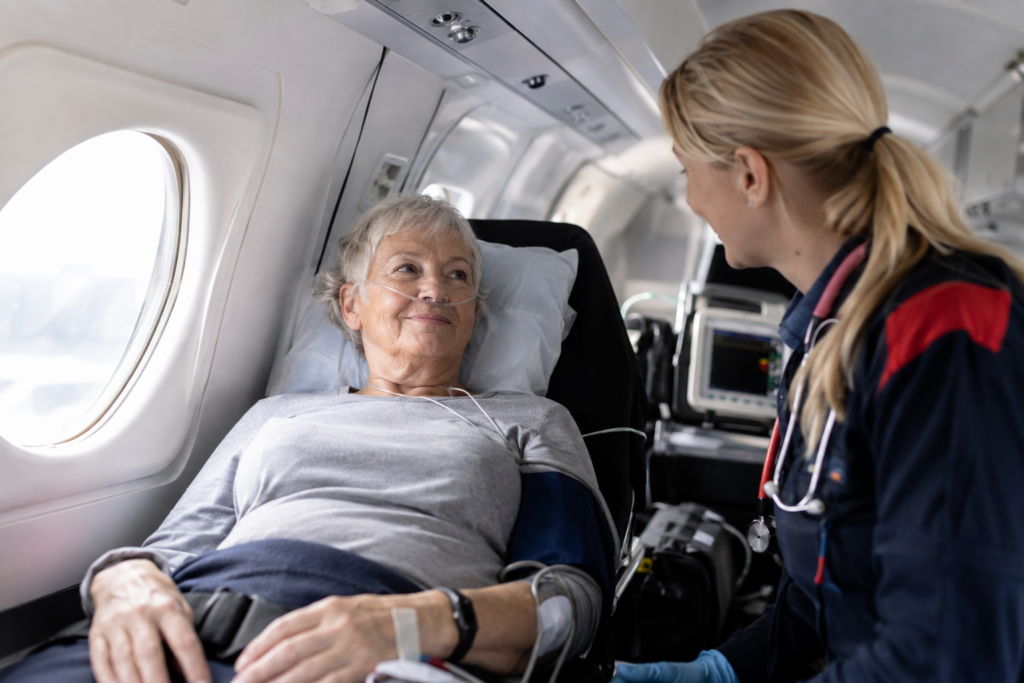
If an ordinary flight home is not suitable after a stroke, the safest transport option depends on the patient’s current condition, mobility and level of medical support. The detailed options are covered in the FAQs below; planning normally begins with a current hospital medical report.
Travel Insurance After a Stroke
Tell your travel insurer about your stroke or TIA and answer medical-screening questions accurately. Cover, exclusions and premiums vary between policies, and a pre-existing medical condition can affect what is covered.
If a stroke occurs abroad, contact the insurer as soon as reasonably possible after emergency treatment is underway. If an insurer declines or delays repatriation, families can still seek a private medical transport quotation. Our guide explains what to do when travel insurance will not cover medical repatriation.
Flying After a Stroke: Practical Checklist
- Ask your treating clinician whether you are medically stable to travel.
- Use the CAA waiting periods as minimum guidance, not automatic clearance.
- Check whether the airline requires medical clearance or a MEDIF form.
- Request airport assistance at least 48 hours ahead where possible.
- Keep essential medication and a medication list in your hand luggage.
- Plan for mobility, fatigue, swallowing, communication and toileting needs.
- Choose simple itineraries where practical and allow enough time for connections.
- Declare the stroke or TIA accurately to your travel insurer.
- Seek urgent medical help for any new stroke or TIA symptoms — do not attempt to fly.
Has someone had a stroke while abroad and cannot travel home normally? Ask SkyCare to assess the medical journey home.
This article was clinically reviewed by Dr Lee Collier on 04/03/2025. It has been editorially updated by SkyCare Repatriation on 19/08/2026 using current NHS and UK Civil Aviation Authority guidance relating to stroke, TIA and air travel. Next clinical review due 04/03/2027 | Originally published on 04/03/2025.
Frequently Asked Questions About Flying After a Stroke
Current UK Civil Aviation Authority neurological guidance advises waiting at least 2 weeks after a stroke. This is a general minimum rather than automatic clearance to fly. Your treating clinician may recommend waiting longer depending on the type and severity of the stroke, its cause, your recovery and any ongoing complications.
The UK CAA advises waiting at least 2 days after a TIA. A suspected TIA still requires urgent medical assessment even when symptoms have completely disappeared, and the cause and risk of a subsequent stroke should be addressed before travel.
Not necessarily. The CAA notes that a stable condition, such as residual weakness following a stroke without further complications, may not require a medical certificate. An airline may request medical information or clearance if the condition is unstable or additional support, oxygen or equipment is required.
Yes. Assistance can be useful for weakness, reduced mobility, balance problems or post-stroke fatigue. The CAA recommends requesting assistance when booking or at least 48 hours before departure where possible.
Some people who have recovered well can travel independently, but others may need a relative, companion or professional medical escort because of mobility, communication, cognitive, swallowing or medication needs. The decision should reflect the individual’s current abilities and medical condition.
Seek emergency medical care locally first. Once the patient has been assessed and stabilised, the treating hospital and medical transport team can decide when travel is appropriate and what support is required. A hospital discharge does not automatically mean someone can safely manage an airport and ordinary passenger flight.
Planning usually starts with a current hospital medical report covering the stroke, neurological condition, mobility, swallowing, medication and ongoing care needs.
No. Discharge means inpatient hospital care may no longer be required; it does not automatically establish that the patient can safely manage transfers, an airport and a commercial flight.
If normal travel is unsuitable, the options can include a commercial medical escort, commercial airline stretcher, private air ambulance or, for suitable European cases, a long-distance road ambulance. The choice depends on the patient’s clinical needs rather than the stroke diagnosis alone.
Ask why travel has not been approved and whether further medical information could change the airline’s decision. Airlines may have their own medical-clearance requirements and can request additional information before accepting a passenger.
If an ordinary flight remains unsuitable, medically supported options can include a medical escort, airline stretcher or air ambulance, depending on the patient’s condition.
The safest method depends on how well the patient has recovered and what support is needed during the journey. A medically stable patient who can use a scheduled flight may travel with a commercial medical escort. Someone who cannot sit upright may sometimes use a commercial airline stretcher.
Patients requiring greater monitoring, oxygen, specialist equipment or more intensive care may need a private air ambulance. In selected neurological cases, the medical and aviation teams may consider whether a sea-level air ambulance flight is clinically appropriate. For suitable journeys within Europe, road ambulance repatriation can sometimes avoid the airport altogether.
A hospital discharge does not always mean a patient can safely manage an ordinary passenger flight.
Had a Stroke Abroad and Need to Get Home?
SkyCare can review the medical information and assess whether a medical escort, commercial stretcher, private air ambulance or European road ambulance is appropriate for the journey home.
Discuss a Stroke Repatriation