 SkyCare
  Air Repatriation
Commercial Medical Escort Booking Process: Step by Step
How to Arrange a Commercial Medical Escort Flight
Arranging a commercial medical escort can feel complicated when a relative is ill or recovering abroad. The flight itself is only one part of the journey: airlines may require medical clearance, hospitals need to provide information, seats and specialist assistance must be arranged, and the patient may need a nurse, paramedic or doctor throughout the journey.
SkyCare coordinates these steps for families, hospitals and case managers. For medically stable patients, a commercial medical escort can be a practical alternative to a private air ambulance. Patients who cannot remain seated may instead require a commercial airline stretcher flight.
Need a Medical Escort Quote?
Tell us where the patient is, where they need to travel and what has happened medically. We can review the case, explain the realistic options and coordinate the airline medical-clearance process.
Do I Need a Medical Escort to Fly Home?
You may need a medical escort if you are medically stable enough to travel on a scheduled airline but still require professional support because of recent illness, surgery, injury, reduced mobility, medication needs, oxygen requirements or general frailty. A medical escort can also be appropriate when a patient is medically fit to fly but should not make the journey alone.
If you are unsure, SkyCare can review the medical information and explain whether a seated medical escort, stretcher flight or private air ambulance is the most realistic option.
What Is a Commercial Medical Escort?
A commercial medical escort is a qualified nurse, critical care paramedic or doctor who accompanies a patient on a normal scheduled airline. The escort provides medical supervision and practical support during the journey while SkyCare coordinates the airline clearance, airport assistance and wider repatriation arrangements.
How Do I Arrange a Medical Escort for a Flight?
Start by giving SkyCare the patient’s current location, destination, medical condition and any recent medical report you have. We assess the case, identify the appropriate level of medical support, check suitable flights and coordinate any airline MEDIF or Fit to Fly requirements before the booking is confirmed.
You do not need to work out the airline paperwork yourself. Our team manages the process with the treating hospital and airline medical department.
Can a Nurse Accompany a Patient on a Commercial Flight?
Yes. Many medically stable patients travel safely with an experienced flight nurse on a scheduled airline. Depending on the patient’s condition, SkyCare may instead recommend a critical care paramedic or doctor. The clinical escort is selected around the patient’s needs rather than using the same level of support for every journey.
Can You Fly Home After Being Discharged from Hospital?
Often, yes — but hospital discharge does not automatically mean an airline will accept the patient for travel. A patient may still need a Fit to Fly assessment, an airline MEDIF form, mobility assistance, oxygen or a medical escort. SkyCare can coordinate directly with the hospital so that the travel plan reflects the patient’s current condition.
Can a Patient Travel in Business Class with a Medical Escort?
Yes, where the airline permits it and the patient’s medical and mobility needs can be safely managed in that cabin. Business class can sometimes provide more space, easier positioning and a more comfortable journey, but it is not automatically the best option for every case. We assess the route, seat type, airline rules and patient needs before recommending it.
The Booking Process at a Glance
| Stage | What happens |
|---|---|
| 1. Initial enquiry | We collect the patient, medical and journey details. |
| 2. Clinical review | We assess whether seated commercial travel, a stretcher flight or another transport method is appropriate. |
| 3. Flight planning | Suitable routes, seats, connections and airline requirements are checked. |
| 4. MEDIF clearance | The airline reviews the patient’s medical information and any requested assistance. |
| 5. Final quotation | Current airfare, medical escort costs and any ground transport or equipment are confirmed. |
| 6. Booking | Tickets, medical team, airport assistance and onward transfers are finalised. |
| 7. Travel | The medical escort accompanies the patient through the agreed journey and clinical handover. |
Step 1 – Tell Us About the Patient and Journey
The first step is giving us enough information to understand the case. We normally need the patient’s current location, destination, medical condition, mobility, recent treatment and the contact details of the treating hospital or clinician.
A recent medical report is extremely useful, but you do not need to have every document ready before contacting SkyCare. If information is missing, we can explain what will be required and, where appropriate, liaise with the treating team.
This initial assessment helps us decide whether a seated medical escort flight is realistic, whether the patient may require a stretcher, or whether scheduled airline travel is not clinically appropriate.
Step 2 – We Assess the Safest Transport Option
Commercial flights are suitable for many medically stable patients, but they are not suitable for everyone. The patient normally needs to be stable enough to tolerate the cabin environment, airport journey and expected duration of travel.
Depending on the medical information, SkyCare may recommend a nurse, critical care paramedic or doctor as the escort. We may also identify requirements such as wheelchair assistance, additional seating, oxygen, a portable oxygen concentrator or specialist ground transport.
If the patient cannot sit upright for the journey, a stretcher flight may be considered. If they require a much higher level of continuous treatment, a private air ambulance may be safer.
Step 3 – We Search for Suitable Flights
Finding a suitable flight is not always as simple as choosing the cheapest ticket. We consider the patient’s condition, connection times, airport accessibility, seat availability, airline medical policies and the practicalities of travelling with medical equipment.
A direct flight is often preferable because it reduces transfers and the overall travel time. However, on some international routes a connection may be unavoidable or significantly more practical.
For stretcher cases, airline choice is even more restricted because many carriers do not offer stretcher installations. Sometimes the patient may need to travel by road ambulance to a larger airport where an appropriate airline and route are available.
Step 4 – Airline MEDIF and Medical Clearance
Many airlines use a MEDIF (Medical Information Form) when a passenger has a significant medical condition or needs special medical support. The airline’s medical department reviews the information before deciding whether the passenger can travel and what conditions must be met.
This is separate from a general Fit to Fly assessment. Even when a treating doctor considers a patient fit to travel, the airline ultimately decides whether it will accept that passenger on its aircraft.
Airline medical departments may ask for further information or impose conditions such as additional medical personnel, approved oxygen equipment, wheelchair assistance, specific seating or a stretcher installation. Approval times vary by carrier and case complexity; some decisions are quick, while others can take several days.
Step 5 – We Prepare Your Quotation
Once we understand the medical requirements and have identified realistic flight options, we prepare a quotation covering the proposed journey. Depending on the case, this can include airfare, the medical escort, medical equipment, ground ambulances, airport assistance and other necessary logistics.
Sometimes there is more than one reasonable option. A direct route may reduce travel time but cost more; an indirect route may reduce airfare while increasing staff time or making the journey harder for the patient. We explain these trade-offs rather than simply presenting the lowest headline price.
For more detail on why prices can change, see our guide to medical escort and stretcher flight pricing.
Step 6 – Medical Clearance, Fares and Seat Availability
This is the stage that often causes confusion. Airline fares and seat availability can change while medical clearance is being processed. An airline may approve the MEDIF only after the original fare has increased or a particular seat is no longer available.
Where possible, SkyCare will explain the financial risk before tickets are purchased. Some clients prefer to wait until airline approval is confirmed; others may choose to secure travel earlier where the fare rules and medical situation make that sensible.
No option is completely risk-free. Buying too early can expose the traveller to cancellation charges if medical clearance is refused, while waiting can lead to higher fares or reduced availability. Our role is to make those risks clear so you can make an informed decision.
Step 7 – Tickets, Medical Team and Logistics Are Confirmed
Once the route and price are agreed, we finalise the booking. This may include purchasing the required seats, confirming the medical escort, arranging airport assistance and making sure approved equipment and medication can travel.
Where a full bed-to-bed medical repatriation is required, we can also coordinate an ambulance or suitable vehicle to collect the patient, the airport handover, the commercial flight and onward transport after landing.
Family members may also be able to travel on the same flight, subject to availability and the practicalities of the medical booking.
Step 8 – Stretcher Flights Need Additional Planning
A commercial stretcher flight is considerably more complex than a standard seated medical escort. The airline normally needs to remove or block several seats and install an approved stretcher system with privacy arrangements.
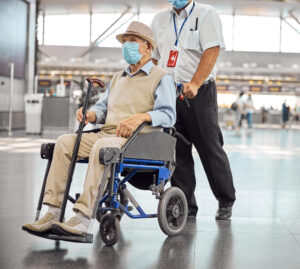
The patient also requires appropriate ground handling at both airports and usually travels with a medical escort throughout. Because only certain airlines and aircraft support this service, the route and timetable can be more restrictive than for a seated passenger.
Read our full guide to commercial stretcher flights.
Step 9 – Medical Equipment, Oxygen and Medication
Airlines place strict rules on medical equipment carried in the cabin. Portable oxygen concentrators normally need to be airline-approved, batteries must meet the carrier’s requirements, and some forms of oxygen or medical equipment may need to be supplied by the airline itself.
Medication also needs planning, particularly where controlled drugs or refrigerated medicines are involved. International rules vary, so the route and destination may affect what paperwork is needed.
SkyCare coordinates these requirements with the medical escort, airline and treating team before departure.
Step 10 – Travel Day and Clinical Handover
On the day of travel, the medical escort supports the patient through the agreed journey. Depending on the case, this may begin at the hospital, home, care facility or airport.
The escort can assist with airport processes, medication and clinical monitoring during the flight, and communication with family or the receiving team. Where onward transport has been arranged, the patient is handed over to the receiving ambulance, hospital, care facility or family at the destination.
The aim is a continuous journey with clear responsibility at every stage rather than leaving the patient or relatives to coordinate separate providers themselves.
How Long Does a Commercial Medical Escort Take to Arrange?
A straightforward seated medical escort can sometimes be organised within a few days, but the exact timescale depends on medical information, airline clearance, route availability and any special assistance required. Stretcher flights typically need more planning because the airline must confirm stretcher availability and complete additional operational arrangements.
For urgent cases, contact us as early as possible. Even if you do not yet have every medical document, we can start by explaining what information is needed and what transport options appear realistic.
Need help now? Request a commercial medical escort quotation or speak to the SkyCare team about the safest way to bring the patient home.
Questions About Medical Escort Flights
A Fit to Fly assessment may be required when a patient has a recent illness, injury, surgery or medical condition. However, the airline may also require its own MEDIF process before accepting the passenger. SkyCare can coordinate the medical information and airline requirements for you.
A MEDIF is a Medical Information Form used by many airlines to assess passengers with significant medical needs. It is reviewed by the airline’s medical department, which decides whether the passenger can travel and what conditions, equipment or assistance are required.
The treating clinician can advise whether the patient appears medically fit to travel, but the airline makes the final decision on whether it will accept the passenger. This is why a Fit to Fly letter and airline approval are not always the same thing.
Often, yes. The airline must approve the oxygen arrangement and may require a suitable portable oxygen concentrator or another approved solution. Battery capacity, flow requirements and airline policy all need to be checked before travel.
A commercial stretcher flight may be appropriate when a patient is stable enough for a scheduled airline but cannot remain seated safely or comfortably for the journey. Stretcher cases need extra airline approval, aircraft availability and ground handling.
An air ambulance is generally considered when the patient is too unwell for scheduled airline travel, needs intensive or continuous treatment, cannot tolerate the commercial cabin environment, or requires a level of medical support that an airline cannot safely accommodate.
The cost depends on the route, current airfare, level of medical escort required, seating, medical equipment, airport assistance and any ground ambulance transfers. SkyCare provides a case-specific quotation once the medical and travel requirements are understood.
Commercial airline fares and seat availability can change while MEDIF approval is being processed. A fare seen at the start of the case may no longer be available when the airline gives final medical clearance, so we re-check pricing before tickets are purchased.
Yes. Where required, SkyCare can coordinate collection from the hospital, care facility or home and arrange the transfer to the departure airport as part of the wider medical repatriation plan.
Yes. For bed-to-bed medical repatriation, SkyCare can arrange ground ambulance transport to the departure airport and a receiving ambulance after landing, with handovers coordinated around the flight and medical escort.
Clear guidance from medical assessment to airline approval and safe arrival
Ready to Arrange a Commercial Medical Escort?
If you need help bringing a patient home on a commercial airline, SkyCare can review the medical information, explain the safest realistic options and coordinate the journey from start to finish.
We can manage airline MEDIF clearance, suitable flights, the medical escort, airport assistance, equipment and onward ground transport where required.
Request a Commercial Medical Escort QuoteRequest a Commercial Medical Escort Quote
Commercial medical escort and repatriation support worldwide